


Why Is My AC Drain Line Clogged? Causes, Fixes & Prevention
Is your AC drain pan filling with water? Discover why summer humidity turns your PVC line into an algae trap.
.jpg)
When the summer rainy season swings into full gear across South Florida, your air conditioning system faces its toughest challenge of the year. While most homeowners focus on how well their system cools the air, your HVAC unit is quietly performing another massive task: extracting gallons of moisture from the humid tropical atmosphere. This process produces a constant stream of wastewater that must exit your home through a narrow PVC pipe. During the summer months, a perfect storm of heat, darkness, and moisture turns this pipe into a prime target for a messy, gelatinous blockage known as white slime.
At Koala Coolin, our local technicians experience a massive spike in clogged drain line service calls throughout Miami-Dade, Broward, and Palm Beach counties. Homeowners in Miami, Fort Lauderdale, Boca Raton, and West Palm Beach often find their systems shutting down completely on a hot afternoon without warning. In most cases, the culprit is not a mechanical failure but a buildup of bacteria and algae inside the condensate line. To help you protect your property from indoor water damage and keep your home cooling efficiently, let's explore why summer is prime time for condensate drain clogs and how to prevent them.
Why Does an AC Drain Line Get Clogged?
An AC drain line becomes clogged when algae, bacteria, mold, dust, and debris accumulate inside the condensate pipe. In South Florida's humid climate, the constant flow of moisture creates ideal conditions for white slime buildup that eventually blocks drainage and can shut down the air conditioner.
According to data from the Environmental Protection Agency (EPA), indoor relative humidity levels above 60% significantly increase microbial and fungal growth. Because South Florida's summer humidity frequently hovers between 70% and 90%, indoor air handler units become highly vulnerable to biological accumulation without advanced air purification or regular HVAC drain line maintenance.
What Is AC Drain Line White Slime?
AC drain line white slime is a thick, gelatinous accumulation of airborne bacteria, yeast, and fungi that thrives inside an air conditioner’s condensate drainage system. Unlike typical outdoor pool algae, this substance does not require sunlight to grow, making your dark, damp PVC drain pipe the ultimate incubation chamber.
As your system pulls warm, humid air across the cold indoor evaporator coil, the moisture condenses into water droplets and drips into a drain pan. This water carries microscopic airborne dust, pollen, and organic particles along with it. When this warm, nutrient-rich water stream slowly trickles through a dark pipe, the bacteria feed on the debris, multiplying rapidly to form a sticky, rubbery bio-film plug that completely chokes off your system's drainage capacity.
Why Do AC Drain Clogs Peak on Hot Summer Days?
An air conditioner running longer than normal during high-humidity heat waves produces far more water than most homeowners realize. This heavy operational volume accelerates biological growth inside your system through several distinct phases:
- Massive Water Production: On a typical hot summer day in South Florida, a standard residential air conditioner can extract anywhere from 9 to 20 gallons of water from your indoor air every single day.
- The Constant Trickle Effect: This massive volume means a warm, continuous stream of water flows through your dark PVC line for hours on end, providing a non-stop supply of moisture and heat for white slime to flourish.
- The Float Switch Tripped Stage: Most modern HVAC systems are equipped with an inline float switch or water safety sensor. When the white algae forms a complete gelatinous plug, the draining water backs up into the pan, lifting the safety float switch. This instantly cuts power to your outdoor compressor to prevent an active indoor water overflow, killing your cooling entirely until the line is cleared.
Signs Your Air Conditioner Has a Clogged Condensate Line
Because your AC drain line is mostly hidden from view, you need to recognize the secondary warning signs of a developing blockage before the water safety switch shuts down your system completely:
- Your digital thermostat suddenly goes completely blank, and the indoor blower fan shuts off unexpectedly during a hot afternoon.
- You notice standing water pooling around the base of your indoor air handler closet or an air conditioner leaking water from your garage ceiling panel.
- A damp, stale, or musty odor wafts through your home every time the central air system kicks on.
- You see the outdoor PVC pipe, which usually drips steadily into your yard or flower bed, completely bone-dry while the unit is running.
- You experience a sudden case of an AC drain pan overflowing, resulting in moisture pooling beneath the unit.
If your thermostat has gone blank or water is pooling around your air handler, scheduling a professional inspection early can prevent expensive drywall and flooring repairs.
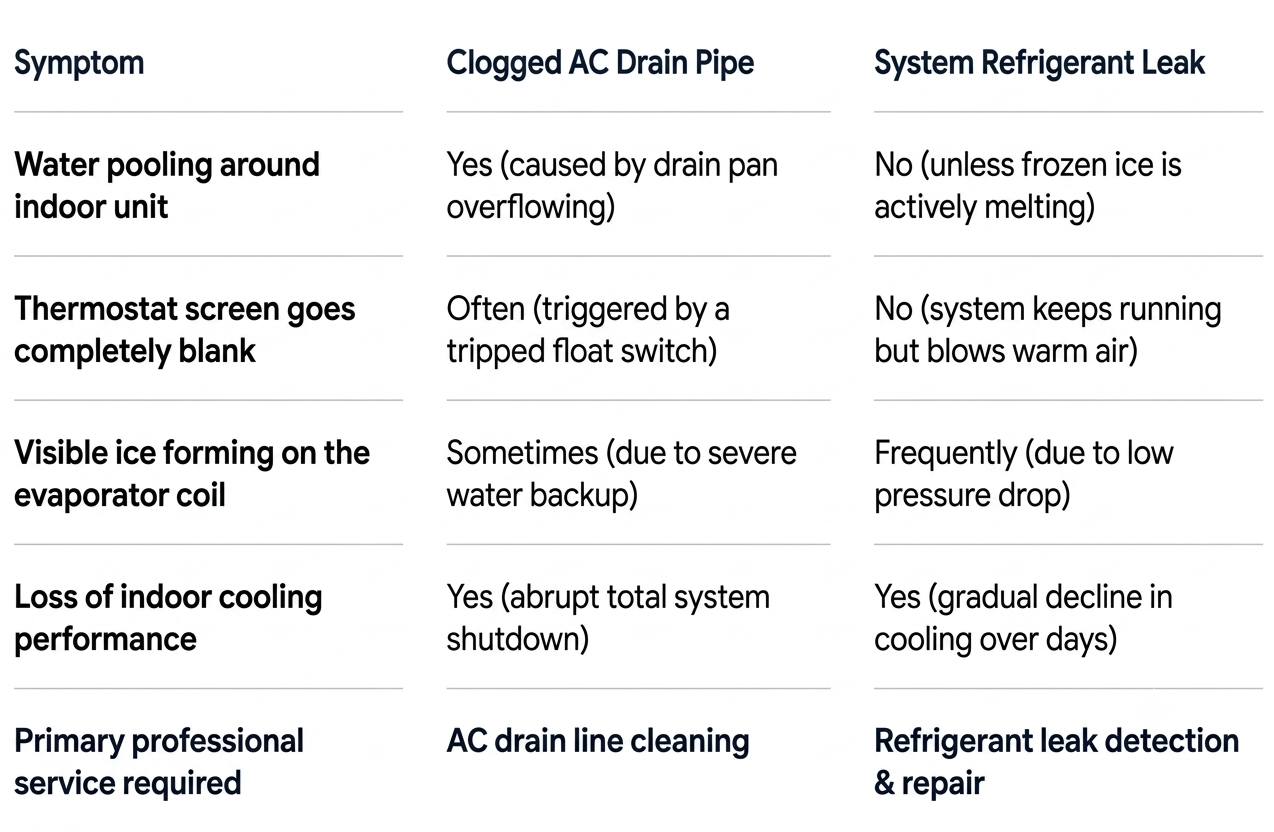
AC Drain Line Clog vs. Refrigerant Leak: How to Tell the Difference
When an air conditioner stops cooling or cuts power entirely, homeowners often struggle to diagnose whether they are facing a drainage issue or a refrigerant problem. Both issues lead to system inefficiency, but they require completely different repair strategies. Use this quick reference to evaluate your system symptoms:
Why Does My AC Drain Line Keep Clogging?
If you find yourself dealing with recurring blockages every few months, your system likely suffers from structural issues rather than simple seasonal buildup. Recurrent clogs typically point to one of these three structural vulnerabilities:
Incorrect Drain Pipe Pitch
Condensate drainage relies entirely on gravity. PVC drain lines must slope downward at a minimum decline of one-quarter inch per linear foot. If the pipe settles, sags, or was installed flat, water stagnation occurs. This standing water creates a permanent pool where bacteria grow continuously, leading to rapid blockages even after the line has been flushed.
Missing or Improper P-Trap Installation
A trap is essential to prevent air from pulling backward through the drain line. In a draw-through system, where the coil is located before the blower fan, the negative air pressure can actually suck air up the drain pipe. This negative pressure creates a siphon effect that traps water inside the drain pan, preventing it from flowing outward while the system runs. The water only drains when the system shuts off, extending the time organic material sits inside your pan.
Severe Biological Material Contamination
If your home suffers from high levels of airborne dust, pet dander, or carpet fibers, your cooling system draws these particles directly into the damp evaporator coil fins. This debris flows straight into the drain pan, creating an abundant food source for white slime bacteria.
Can a Bad Thermostat Cause AC Short Cycling?
It is easy to mistake a tripped float switch for a thermostat electrical failure. When white algae blocks your drainage pipe, the safety float switch cuts the 24-volt control power to protect your home from water damage. Because many digital thermostats rely on this same 24-volt circuit for power, the thermostat screen turns off completely, making it look like a bad thermostat or a loose control wire when the root cause is actually an active water backup.
Can an Oversized Air Conditioner Cause Short Cycling?
An oversized system lowers room temperatures so rapidly that it runs short, abrupt cycles. Because it shuts off within minutes, the indoor evaporator coil never stays cold long enough to properly dehumidify the air. This creates an environment with high indoor humidity, leaving your home sticky and damp, which accelerates biological mold and white slime formation on your walls, supply vents, and inside your HVAC drainage pan.
How Do You Clear a Clogged AC Drain Line?
Clearing a residential condensate line requires specialized tools to safely extract the rubbery white slime plug without fracturing hidden PVC joints inside your walls.
- Vacuum Extraction: Technicians utilize specialized wet/dry high-lift vacuums attached to the exterior termination point of the PVC line to pull the entire bio-film plug downward out of the home.
- Nitrogen Pressure Flushes: For stubborn, impacted plugs, a regulated blast of dry nitrogen gas is sent through an access valve to break up the mass and clear the pipe walls cleanly.
- Chemical Treatment Pads: Once the pipe is completely clear, time-release algaecide tablets are placed inside the primary drain pan to safely inhibit bacterial growth for up to six months.
How Much Does AC Drain Line Cleaning Cost in South Florida?
The cost of professional condensate drain cleaning depends heavily on whether the blockage is caught early or has already caused a system shutdown. A standard preventative flush performed during an air conditioner tune-up is highly affordable and avoids emergency premiums. However, if the line requires intensive nitrogen pressure clears, inline safety switch replacements, or extensive diagnostic tracing through finished drywall, the cost will increase depending on the complexity of the piping and accessibility.
What Our South Florida HVAC Technicians See In The Field
During the summer months, our technicians commonly find that a complete lack of regular maintenance combined with poor pipe configuration is the leading cause of emergency drain line issues. We frequently encounter drain pans overflowing with thick white sludge because a simple flush was ignored in the spring. Left untreated, this backing water can ruin electronics, rust out your emergency pan, and create long-term structural moisture problems inside your home.
Preventative Solutions for Homeowners Across South Florida
The most effective way to secure your property against an indoor water overflow is to implement professional clearing methods and hardware upgrades. Our team provides comprehensive local service across Miami-Dade, Broward, and Palm Beach Counties, ensuring your drainage loop stays completely clear:
- In Miami, Hialeah, Kendall, Doral, Cutler Bay, and Miami Gardens, we perform high-pressure AC drain line cleaning to blast out stubborn bio-film plugs from long, complex pipe runs.
- In Fort Lauderdale, Hollywood, Sunrise, Plantation, Coral Springs, Cooper City, Weston, and Pembroke Pines, our technicians execute meticulous evaporator coil cleaning to remove the organic dust and debris that feeds the bacteria inside the pan.
- In Boca Raton, Deerfield Beach, Delray Beach, Boynton Beach, Wellington, Jupiter, Lake Worth, Royal Palm Beach, and West Palm Beach, we provide comprehensive AC maintenance in South Florida, focusing on testing safety float switches, treating pans with specialized treatments, and upgrading older systems.
The Ultimate Defense: Installing an EZ Trap Cleanout Port
If your current PVC line is permanently glued together without an open access point, it is incredibly difficult to clear or maintain safely. During a standard AC tune-up service, our technicians can cut away old, inaccessible piping and install an easily accessible clear cleanout port (such as an EZ Trap). This transparent port allows you to visually inspect the water flow and gives you a dedicated opening to easily clear the line without damaging your equipment.
Frequently Asked Questions (FAQs)
Can a clogged AC drain line cause water damage?
Yes. If your system lacks a functional safety float switch, an active drainage block will cause thousands of gallons of condensed water to overflow directly out of the primary drain pan. This can quickly ruin insulation, rot structural wood studs, destroy ceiling drywall, and ruin flooring below your air handler closet.
How do I know if my AC float switch is bad?
If your AC drain pan is completely full of standing water or actively overflowing, but your air conditioner continues to run and blow warm air, your safety float switch is either stuck, wired incorrectly, or completely broken. It should have cut power to your compressor immediately upon detecting the rising water.
Should I pour vinegar into my AC drain line?
Regular white vinegar can help slow down minor algae growth if poured down an open cleanout port once a month. However, vinegar is not strong enough to break up an existing, gelatinous white slime plug once a solid blockage has already formed. A solid clog requires professional mechanical extraction or a pressure flush.
How much water should come out of an AC drain line?
During high-humidity summer days in South Florida, a healthy, correctly sized residential air conditioner should discharge anywhere from 5 to 20 gallons of water per day. You should see a steady, consistent drip or trickle from your exterior PVC pipe whenever the outdoor unit is running.
Is white slime in an AC drain line dangerous?
While the white slime itself is a non-toxic mix of common environmental bacteria and fungi, the standing water it creates is a major hazard. Stagnant drain water encourages secondary mold spore growth inside your air handler closet, which can significantly compromise your indoor air quality solutions and trigger respiratory issues.
Protect Your Property with Koala Coolin
If your air conditioner is running constantly, short-cycling, or suffering from an air conditioner leaking water dilemma during the summer rainy season, Koala Coolin can help. Our comprehensive maintenance plans, safety switch testing, and advanced indoor air quality solutions keep your central cooling system operating safely and efficiently all summer long.
Do not wait for a hidden drainage clog to ruin your drywall or disrupt your home comfort. Let our experienced local team perform a professional line flush, update your pipe configuration, and deliver an expert emergency AC repair if you are facing an active system shutdown.
Give Koala Coolin a call today at 754-282-7082 to schedule your comprehensive drain line inspection and system safety tune-up!
.jpg)
.jpg)
.jpg)