How Long Do AC Units Actually Last in Broward vs. the National Average?
The national median AC lifespan is 15 years — but in Palm Beach and Broward, 8–12 is the reality, and coastal systems fare worse. Here's why, and how to close the gap.
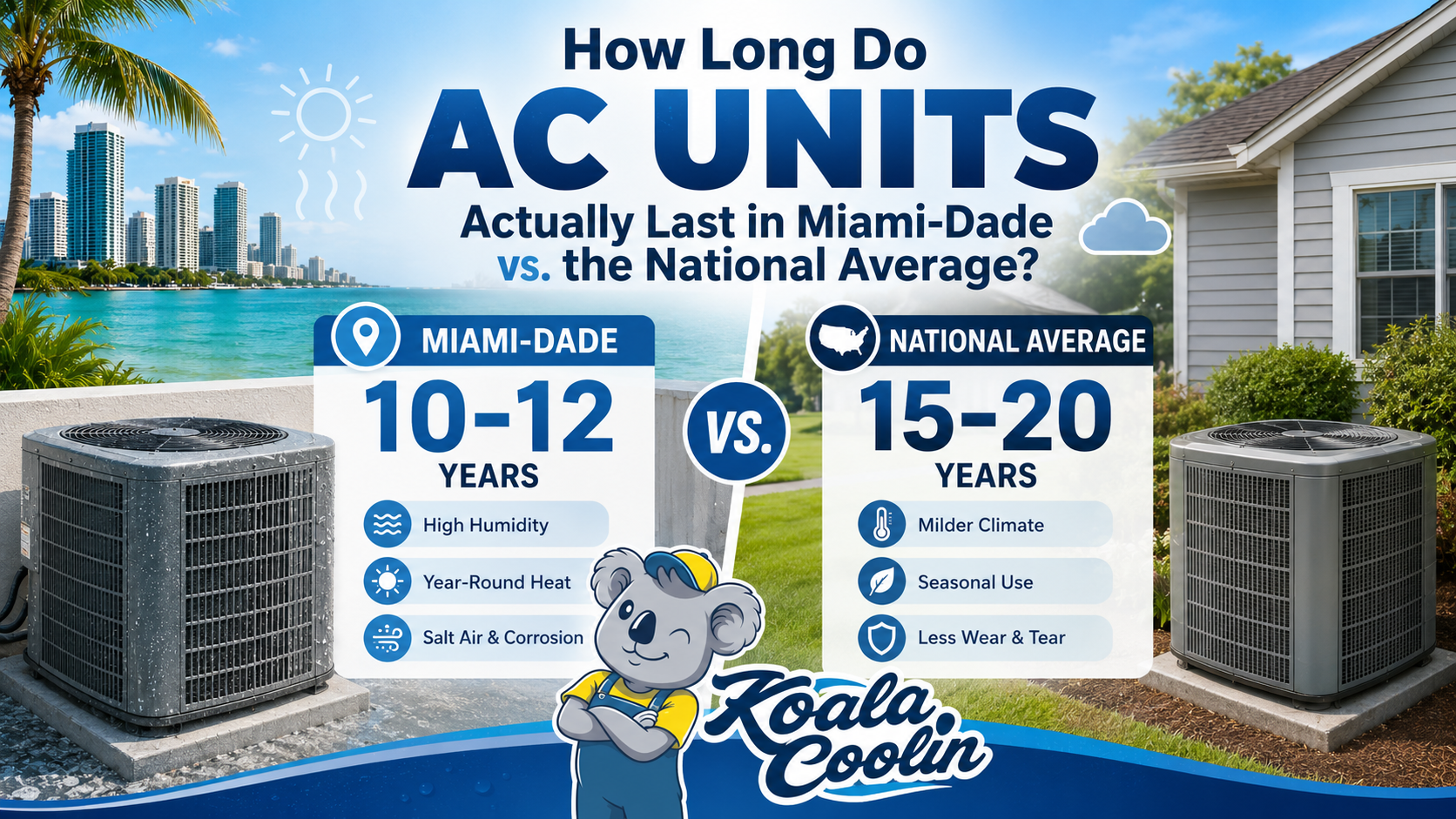
The short answer: nationally, a central air conditioner has a median service life of 15 years, according to ASHRAE's equipment life expectancy data. In Miami-Dade, Broward, or Palm Beach, our technicians typically see systems last 8–12 years — and as little as 7–10 years for units within a mile or two of the ocean. The gap comes down to three things: runtime, salt, and humidity.
Here's the honest breakdown of why South Florida is so hard on air conditioners, what actually kills them here, and how to get closer to that national number.
AC Lifespan: South Florida vs. the National Average
| System type | National median (ASHRAE) | Typical in Miami-Dade | Coastal Miami-Dade |
|---|---|---|---|
| Central split-system AC | 15 years | 10 – 12 years | 7 – 10 years |
| Air-to-air heat pump | 15 years | 10 – 12 years | 7 – 10 years |
| Window unit | 10 years | 6 – 8 years | 5 – 7 years |
| Ductless mini-split | 15 – 20 years | 12 – 15 years | 10 – 12 years |
The national figures are ASHRAE medians — the industry benchmark used by engineers to plan equipment replacement. The Miami-Dade figures reflect what we see in the field across thousands of service visits in South Florida; they're not a lab number, and a well-maintained inland system can absolutely beat them.
Why Do AC Units Wear Out Faster in Miami-Dade?
Your AC simply runs more — a lot more
Air conditioner lifespan is better measured in runtime hours than calendar years, and Miami's cooling season never really ends. In just the first half of 2026, Miami logged 2,202 cooling degree days — 340 above its own normal — per NOAA's Climate Prediction Center. Most of the country accumulates less cooling demand in an entire year than South Florida does by early July. A compressor that would cycle a few hours a day for four months in Ohio runs nearly year-round here, so a "10-year-old" Miami system has often worked the equivalent of 20+ northern years.
Salt air corrodes the outdoor unit
From Sunny Isles to Homestead, salt-laden air settles on the condenser's aluminum fins and copper coils, trapping moisture and eating through the metal. Corroded coils lose heat-transfer capacity, refrigerant leaks develop at weakened joints, and electrical connections degrade. This is why the same equipment installed in Kendall and in Key Biscayne can have lifespans that differ by three to five years.
Humidity and storm season finish the job
Year-round humidity means the system dehumidifies constantly (extra load), condensate drains clog with algae, and biological growth attacks evaporator coils. Summer lightning and grid fluctuations add electrical stress — failed capacitors and fried control boards after storms are among our most common calls.
What Actually Fails First in South Florida
In our experience, Miami-Dade systems rarely die all at once — they get expensive to keep alive. The usual sequence: capacitors and contactors fail early and often (cheap fixes), then coil corrosion causes refrigerant leaks (moderate), and finally the compressor gives out (the repair that usually isn't worth making on an older unit). If you want the price tags for each stage, see our 2026 South Florida AC repair cost guide.
How to Get More Years Out of a Miami-Dade AC
The lifespan gap isn't destiny. The systems we see reach 15+ years here almost always have the same things in common:
- Twice-a-year professional maintenance. Coil cleaning, refrigerant checks, electrical testing, and drain treatment catch the small failures before they cascade. In this climate, the national "once a year" advice isn't enough.
- Coastal protection. For homes near the water: factory coil coatings (or aftermarket corrosion treatment), regular fresh-water rinses of the condenser, and corrosion-resistant fasteners and pads.
- A whole-home or condenser surge protector. Cheap insurance against storm-season electrical damage.
- Correct sizing at installation. An oversized unit short-cycles and dies young; proper load calculation matters more in humid climates than anywhere else, because short cycles also fail to dehumidify.
- Keep the drain line clear. A $10 quarterly dose of drain treatment prevents the float-switch shutdowns and water damage that plague South Florida systems.
When Is It Time to Replace Instead of Repair?
ENERGY STAR's guidance is to start considering replacement once an AC or heat pump passes 10 years old — and notes that a properly installed high-efficiency unit can cut cooling costs by up to 20%. In Miami-Dade, where the AC dominates the electric bill, that math tilts toward replacement earlier than the national norm. Our rule of thumb: multiply the repair quote by the system's age in years, and if the result tops $5,000, put the money toward new equipment instead.
Frequently Asked Questions
How long does an AC last near the ocean in Miami?
Typically 7–10 years without protective measures. Salt-air corrosion of the outdoor condenser is the limiting factor. Coil coatings, periodic fresh-water rinses, and twice-yearly maintenance can push a coastal system into the 12–15 year range.
Is a 12-year-old AC in Miami-Dade too old?
It's past the local average, and per ENERGY STAR it's two years beyond the point where replacement should be on the table. If it's running well, keep maintaining it — but budget for replacement, and avoid putting four-figure repairs into it.
Do heat pumps last as long as ACs in South Florida?
ASHRAE gives both a 15-year national median, and locally we see similar 10–12 year real-world lifespans. Since South Florida heat pumps barely run in heating mode, their wear profile is nearly identical to a straight-cool system's.
Does maintenance really extend AC lifespan?
Yes — it's the single biggest controllable factor. Most premature failures we see trace back to preventable causes: corroded coils that were never cleaned, low refrigerant from small unfixed leaks, and clogged drains stressing the system. Well-maintained systems here routinely outlive neglected ones by 3–5 years.
Find Out Where Your System Stands
If your AC is approaching the 8–12 year window, a maintenance visit can tell you whether you're looking at a few more good years or a replacement conversation. Contact us to schedule one anywhere in Miami-Dade, Broward, or Palm Beach — or run our free online estimator to see what a replacement would actually cost.
Sources: ASHRAE Equipment Life Expectancy chart (median service life by equipment type); NOAA Climate Prediction Center — Cooling Degree Days (Miami CDD data, Jan–Jul 2026); ENERGY STAR — When is it time to replace? National figures are published medians; Miami-Dade ranges reflect Koala Coolin field experience across South Florida service visits.