How to Improve Commercial HVAC Efficiency in South Florida
Commercial HVAC systems in South Florida work hard year-round, making efficiency essential for controlling operating costs and maintaining tenant comfort. Learn how preventive maintenance, proper airflow, updated controls, humidity management, and strategic equipment planning can improve performance and reduce unnecessary energy waste.
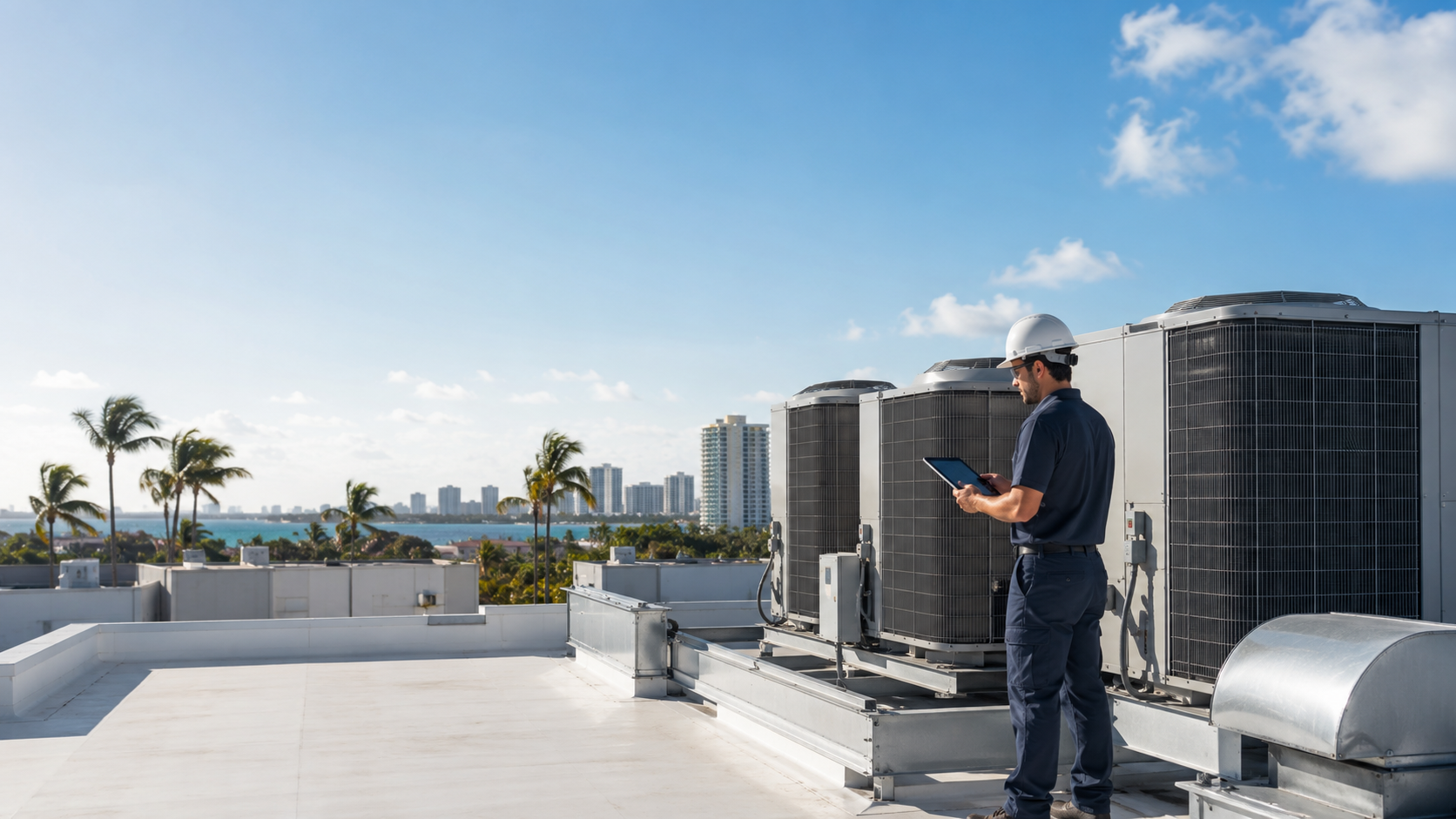
How to Improve Commercial HVAC Efficiency in South Florida
For commercial property owners in South Florida, air conditioning is not a seasonal expense. It is an essential building system that may operate throughout most of the year.
When a commercial HVAC system becomes inefficient, the effects can extend beyond a higher electric bill. Tenants may complain about inconsistent temperatures, employees may become uncomfortable, equipment may experience additional wear, and unexpected breakdowns can disrupt business operations.
The good news is that improving HVAC efficiency does not always require replacing every unit. Many commercial buildings can reduce energy waste and improve performance through better maintenance, controls, airflow management, and informed equipment planning.
Here are some of the most important areas commercial property owners and facility managers should evaluate.
1. Start With a Commercial HVAC Inspection
Before investing in upgrades, it is important to understand how the existing system is performing.
A commercial HVAC inspection should evaluate more than whether the equipment turns on and produces cold air. The technician should examine the condition and operation of the complete system, including:
- Rooftop units, split systems or water-source heat pumps
- Refrigerant pressures and temperatures
- Electrical components and operating amperage
- Evaporator and condenser coils
- Blower motors, belts and bearings
- Filters and outside-air components
- Thermostats and control settings
- Supply and return airflow
- Condensate drains and drain pans
- Ductwork condition and leakage
- Temperature differences throughout the property
This provides a baseline for determining whether the primary problem is equipment condition, poor airflow, incorrect controls, deferred maintenance or a combination of issues.
2. Keep Coils and Filters Clean
Dirty filters and coils restrict airflow and make HVAC equipment work harder to maintain the desired temperature.
In South Florida, commercial equipment is exposed to moisture, salt air, landscaping debris, grease, dust and other contaminants. Rooftop equipment can become especially dirty because it is continuously exposed to outdoor conditions.
Filters should be inspected and changed according to the building’s use and operating environment. A lightly occupied office may have different requirements than a restaurant, medical office, retail store or warehouse.
Condenser and evaporator coils should also be inspected and cleaned as needed. Clean coils allow heat to transfer more effectively, helping the system operate with less strain.
3. Confirm That Thermostat Schedules Match Occupancy
One of the simplest ways to reduce unnecessary HVAC operation is to make sure the system schedule matches the building’s actual hours.
Commercial systems are frequently found cooling empty spaces because:
- The thermostat schedule was never updated
- A tenant changed operating hours
- Holiday schedules were not programmed
- Employees are overriding thermostat settings
- Equipment is starting too early or running too late
- Multiple units have conflicting schedules
Programmable thermostats, connected controls and building automation systems can help property managers schedule equipment more accurately.
More advanced controls may also allow building operators to monitor temperatures, identify faults and adjust equipment based on occupancy. The U.S. Department of Energy identifies properly designed controls, scheduling and fault detection as important components of high-performance commercial HVAC operation.
4. Address Airflow Problems
An HVAC unit can be mechanically operational and still perform poorly because of an airflow problem.
Common commercial airflow issues include:
- Clogged filters
- Dirty blower wheels
- Loose or worn belts
- Closed or improperly adjusted dampers
- Blocked return-air pathways
- Damaged or disconnected ductwork
- Poorly balanced supply vents
- Undersized return-air systems
- Changes to the floor plan without corresponding duct modifications
For example, a building may have been divided into new offices after the original HVAC system was designed. Walls may have been added without relocating supply vents or providing adequate return-air pathways.
This can create hot and cold areas even when the equipment itself is functioning properly.
Air balancing and ductwork modifications can often improve comfort without immediately replacing the HVAC equipment.
5. Control South Florida Humidity
Temperature is only one part of indoor comfort. Humidity also has a major effect on how a commercial property feels and how the HVAC system operates.
A building may reach the thermostat setting but still feel warm or uncomfortable when indoor humidity remains high.
Excessive humidity can also contribute to:
- Musty odors
- Condensation
- Damage to finishes or inventory
- Indoor air-quality concerns
- Tenant complaints
- Additional strain on cooling equipment
Humidity problems can be caused by oversized equipment, excessive outside air, duct leakage, poor building pressure, short equipment cycles or inadequate moisture removal.
The correct solution depends on the building. It may involve airflow adjustments, control changes, equipment staging, outside-air corrections or dedicated dehumidification.
6. Check the Condition of Commercial Ductwork
Leaking or poorly insulated ductwork can waste conditioned air before it reaches the occupied space.
This is particularly important when ductwork is located above a hot ceiling, inside an unconditioned area or on a commercial roof.
A duct inspection may identify:
- Disconnected sections
- Failed insulation
- Air leakage at joints
- Damaged flexible duct
- Poorly sealed plenums
- Improper transitions
- Condensation around ductwork
- Restrictions affecting system airflow
Repairing these conditions can improve both comfort and system efficiency.
7. Avoid Replacing Equipment Based on Tonnage Alone
When a commercial unit needs replacement, installing another unit with the same tonnage is not always the best approach.
The building may have changed since the original system was installed. Occupancy, lighting, windows, insulation, equipment loads, ventilation requirements and interior layouts can all affect the cooling load.
An oversized system may cool the space quickly but run for short periods, which can reduce humidity removal. An undersized system may operate continuously and still struggle to maintain the desired temperature.
Commercial equipment should be selected based on the building’s current requirements, not only the capacity listed on the old unit.
8. Compare More Than the Purchase Price
The least expensive commercial HVAC unit is not always the least expensive system to own.
Property owners should consider:
- Equipment efficiency
- Expected operating hours
- Warranty coverage
- Availability of replacement parts
- Serviceability
- Compressor and fan technology
- Staging or variable-capacity operation
- Compatibility with existing controls
- Coastal corrosion protection
- Expected maintenance requirements
- Estimated service life
For some properties, a standard system may be appropriate. Buildings with extended operating hours or changing occupancy may benefit from staged, variable-speed or inverter-driven equipment.
The right choice depends on the application and expected return on investment.
9. Use Preventive Maintenance to Find Problems Early
Preventive maintenance is one of the most effective ways to protect commercial HVAC efficiency.
A proper maintenance program gives technicians an opportunity to identify deteriorating components before they cause a shutdown.
Depending on the equipment and property, commercial maintenance may include:
- Replacing filters
- Cleaning drain lines
- Inspecting coils
- Checking refrigerant operation
- Measuring motor amperage
- Inspecting electrical connections
- Checking capacitors and contactors
- Inspecting belts and bearings
- Testing thermostats and controls
- Documenting equipment condition
- Recording temperatures and operating readings
- Providing repair recommendations with photographs
Maintenance records also help property owners plan capital improvements instead of reacting to every failure as an emergency.
10. Track Performance Over Time
Commercial HVAC efficiency should be measured rather than assumed.
Property owners can monitor:
- Monthly energy consumption
- HVAC repair frequency
- Tenant comfort complaints
- Runtime trends
- Indoor temperature and humidity
- Maintenance expenses by unit
- Equipment age and condition
- Repeated failures involving the same system
ENERGY STAR Portfolio Manager is one tool commercial property owners can use to benchmark building energy performance and compare results over time.
Even without a full building automation system, organized service records and utility data can reveal which units are becoming expensive to operate.
Signs Your Commercial HVAC System May Be Wasting Energy
Schedule a professional evaluation when you notice:
- Rising electric bills without a clear explanation
- Units running continuously
- Frequent thermostat adjustments
- Uneven temperatures
- High indoor humidity
- Repeated service calls
- Unusual noises or vibration
- Dirty or deteriorated rooftop equipment
- Employees using portable fans or space heaters
- Older equipment operating during long business hours
- Tenants consistently complaining about comfort
These symptoms do not automatically mean the system needs replacement. However, they indicate that the building should be evaluated before the problem becomes more expensive.
Build an Efficiency Plan for Your Property
The most effective commercial HVAC efficiency plans usually combine several improvements rather than relying on one upgrade.
A practical plan may include:
- Inspecting and documenting every HVAC unit
- Correcting urgent mechanical and electrical issues
- Cleaning coils and replacing filters
- Repairing airflow and ductwork problems
- Updating thermostat schedules and controls
- Addressing indoor humidity
- Prioritizing aging equipment for replacement
- Tracking energy use and service history
This allows property owners to address immediate waste while preparing for future capital expenses.
Commercial HVAC Service From Koala Coolin
Koala Coolin provides commercial HVAC maintenance, diagnostics, repairs and equipment replacement throughout Broward, Palm Beach and Miami-Dade counties.
We work with property owners, business owners, facility managers and commercial property managers to improve comfort, reduce downtime and develop practical plans for their HVAC equipment.
Our commercial services include:
- Preventive HVAC maintenance
- Commercial AC repair
- Rooftop unit service and replacement
- Split-system replacement
- Water-source heat-pump service
- Ductwork and airflow improvements
- Thermostat and control solutions
- Indoor humidity evaluation
- Equipment condition reporting
- Planned system replacements
Do not wait for an unexpected equipment failure to evaluate your commercial HVAC system.
Contact Koala Coolin to schedule a commercial HVAC inspection and identify opportunities to improve your property’s comfort, reliability and efficiency.